2-Spring核心模块——Aware接口
原文:CSDN(历史文章导入,当前状态为草稿)
普通的Bean 不需要主动获取 Spring 容器的引用,也不需要调用容器的 API.
但是实际开发的时候,我们经常要用到Spring容器本身的功能资源,所以Spring容器中的Bean需要有主动获取Spring容器的引用和全局信息的能力.
我们可以通过Spring提供的一系列接口Spring Aware来实现具体的功能。
Aware翻译过来:“感知”,如果是XxxAware也就是对…感知的。
普通Bean(无感知,低耦合)
Section titled “普通Bean(无感知,低耦合)”// 这是 Spring Boot 源码中的典型例子 @Component public class MyComponent { // 看!没有导入任何 Spring 容器相关的类 // 只用了 @Component 注解(这是元数据,不是运行时依赖)
private final SomeService service;
// 构造函数注入 - Spring 帮你注入,但你不需要知道"谁"注入的 public MyComponent(SomeService service) { this.service = service; }
public void doWork() { service.execute(); // 完全不需要知道 Spring 容器的存在 // 不需要调用 context.getBean() // 不需要知道自己是被 Spring 管理的 } }关键点:
- Bean 在容器里
- Spring 会注入依赖
- 但 Bean 的代码里没有容器的 API 调用(这才是“无感知”的真正含义)
需要主动访问容器的 Bean(有感知)
Section titled “需要主动访问容器的 Bean(有感知)”// 如果你需要"主动获取容器中的信息" public class AdvancedComponent implements ApplicationContextAware {
private ApplicationContext context; // 持有容器引用
@Override public void setApplicationContext(ApplicationContext context) { this.context = context; // Spring 注入容器本身 }
public void doAdvancedWork() { // 主动调用容器 API 获取信息 String[] beanNames = context.getBeanDefinitionNames(); Environment env = context.getEnvironment(); context.publishEvent(new CustomEvent());
// 这就是"感知容器"的意思 } }| 维度 | 普通 Bean(无感知) | Aware Bean(有感知) |
|---|---|---|
| 是否在容器中? | 是 | 是 |
| Spring 是否注入依赖? | 是 | 是 |
| 代码中是否调用容器 API? | 否 | 是 |
| 是否持有容器引用? | 否 | 是 |
| 能否主动获取容器信息? | 否 | 是 |
| 可移植性 | 高(可换容器) | 低(绑定 Spring) |
Aware接口是一种框架辅助属性注入的一种思想,其他框架中
瞧一眼源码:
/** * Marker superinterface indicating that a bean is eligible to be * notified by the Spring container of a particular framework object * through a callback-style method. Actual method signature is * determined by individual subinterfaces, but should typically * consist of just one void-returning method that accepts a single * argument. * * <p>Note that merely implementing {@link Aware} provides no default * functionality. Rather, processing must be done explicitly, for example * in a {@link org.springframework.beans.factory.config.BeanPostProcessor BeanPostProcessor}. * Refer to {@link org.springframework.context.support.ApplicationContextAwareProcessor} * and {@link org.springframework.beans.factory.support.AbstractAutowireCapableBeanFactory} * for examples of processing {@code *Aware} interface callbacks. * * @author Chris Beams * @since 3.1 */public interface Aware {
}
我们可以看到,Aware是一个具有标识作用的超级接口,实现该接口的Bean都具有被Spring容器通知的能力。
而被通知的方式就是通过回调.
简单来说:直接或者间接实现了这个接口的类,都具有被Spring容器通知的能力。
Aware接口是回调,监听器和观察者设计模式的混合,它表示bean有资格通过回调方式被Spring容器通知。
有时我们的在Bean的初始化中使用Spring框架自身的一些对象来执行一些操作,比如:
- 获取ServletContext的一些参数。
- 获取ApplicationContext中的BeanDefinition的名字。
- 获取Bean在容器中的名字等等。
这些接口均继承自org.springframework.beans.factory.Aware标记接口,并提供一个将由Bean实现的Set方法,Spring通过基于Setter的依赖注入方式使相应的对象可以被Bean使用。
常见的Aware接口:
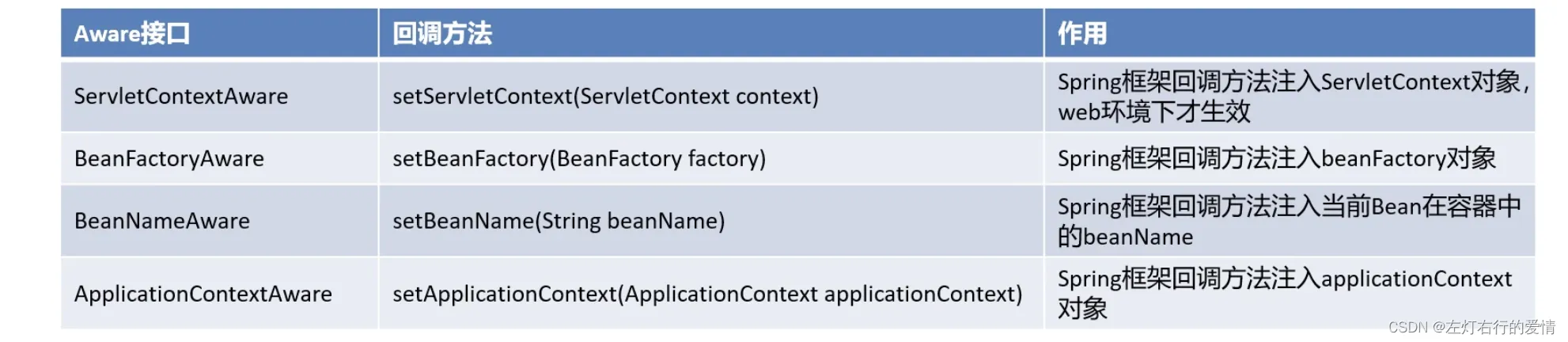
以BeanNameAware为例:
BeanNameAware:使对象能够知道容器中定义的bean名称。
public class MyBeanName implements BeanNameAware { @Override public void setBeanName(String beanName){ System.out.println(beanName); }}在Spring配置 类 中注册这种类型的bean:
@Configurationpublic class Config{  @Bean(name="WangBeanName")  public MyBeanName getMyBeanName(){  return new MyBeanName();}
}
启动应用程序上下文并从中获取bean:
AnnotationConfigApplicationContext context = new AnnotationConfigApplicationContext(Config.class);MyBeanName myBeanName = context.getBean(MyBeanName.class);从控制台可以看到,setBeanName方法打印出来了“WangBeanName”。
若从@Bean注解中删除name =“…”代码,则在这种情况下,将getMyBeanName()方法名称分配给bean,所以输出将是“getMyBeanName”。
对于这个接口我觉得说这么多就好,其实重点在于它的设计模式,后面写到设计模式的时候我再把它拿回来说。