集合专辑(三):List实现类LinkedList解读
原文:CSDN(历史文章导入,当前状态为草稿)
我们之前了解过了ArrayList,现在再来看LinkedList就已经很简单了,但值得一提的是,两者的数据结构不同导致了他们在使用场景注定是有区别的。
- 底层实现了双向链表和双端队列特点(如果你还不了解链表,建议先去学习一下,或者参考我之前写的文章https://blog.csdn.net/qq\_45852626/article/details/122464194?spm=1001.2014.3001.5501),实现了栈和队列的操作方法,可以作为栈、队列使用
- 它可以添加任意元素(元素可以重复),包括null
- 它是线程不安全,没有实现同步(没有锁维护)
- 维护了一个双向链表,所以不存在容量不足的问题,因此没有扩容的方法
- 维护了两个属性first和last分别指向首节点和尾结点
- 每个节点里面维护了prev,next,item三个属性
prev指向前一个,next指向后一个,item是元素。
LinkedList结构
Section titled “LinkedList结构”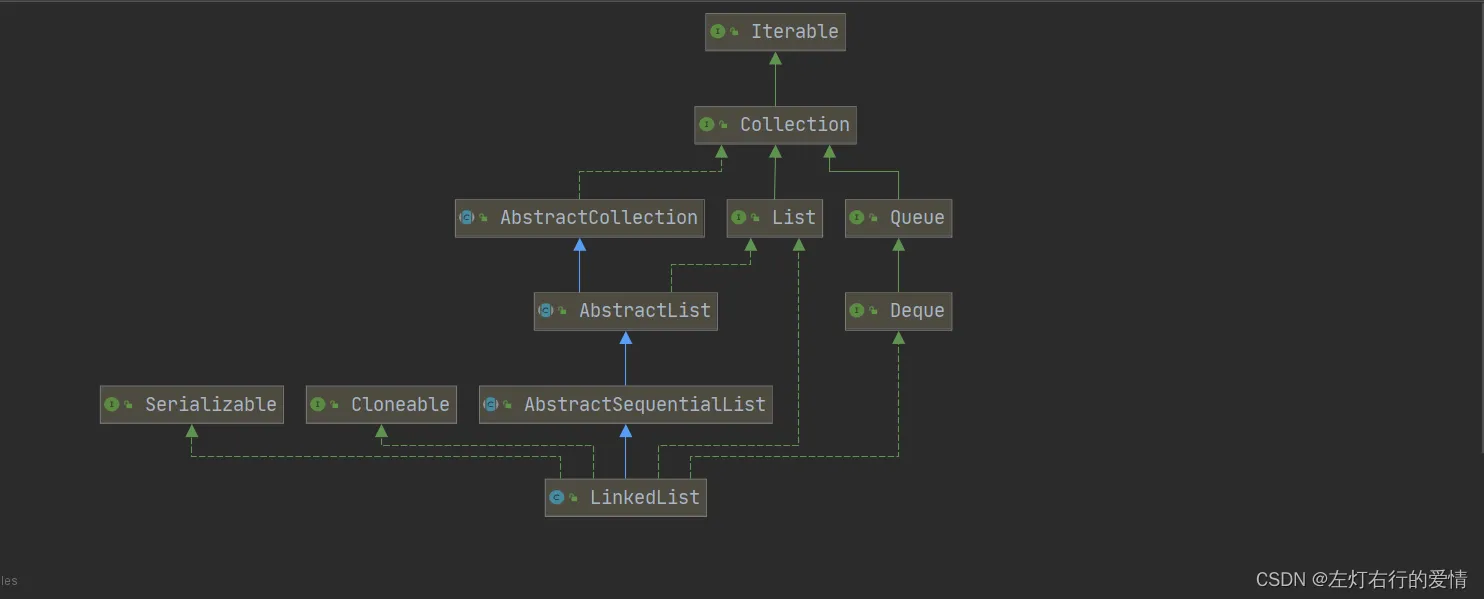
继承和实现的方法和接口
Section titled “继承和实现的方法和接口”代码:

- AbstractSequentialList:继承AbstractList抽象类,使用实现的公共方法。
这个建议去看ArrayList那篇,已经解读过了,在这不多说了。 - List:实现List接口操作规范,增删遍历等操作。
- Cloneable:提供可拷贝功能.
- Deque:继承自Queue,在Queue的增删查基础上,增加了双端操作对应的接口,外加push/pop的栈操作

定义线性Collection,它实际是双端队列的简称(double ended queue),大多数Deque接口的实现不会限制元素数量,但是这里有限制,最大容量为Integer.MAX_VALUE - Serializable 接口: 实现了该接口标示了类可以被序列化和反序列化。
/** * Doubly-linked list implementation of the {@code List} and {@code Deque} interfaces. * 双向链表实现了List和Deque接口 * Implements all optional list operations, and permits all * elements (including {@code null}).         实现了所有list操作,并且允许有null元素 * * <p>All of the operations perform as could be expected for a doubly-linked * list. * 所有的操作都和双向链表是一样的 * Operations that index into the list will traverse the list from * the beginning or the end, whichever is closer to the specified index. *索引到列表的操作将会从列表开始或结束位置(以距离索引更新的位置为准)去遍历列表。 * <p><strong>Note that this implementation is not synchronized.</strong> * 注意它并没有采用synchronized锁实现, * If multiple threads access a linked list concurrently, and at least * one of the threads modifies the list structurally, it <i>must</i> be * synchronized externally.  (A structural modification is any operation * that adds or deletes one or more elements; merely setting the value of * an element is not a structural modification.) * 如果多线程并发的访问一个链表,并且至少有一个线程修改了链表的结构, * 那么它必需采用同步的方式,(结构修改是指添加或删除一个或多个元素的任何操作。仅仅改变元素的值不算结构的修改)。 *  This is typically  accomplished by synchronizing on some object that naturally * encapsulates the list. * 这通常是通过自然封装列表对象进行同步实现 * * If no such object exists, the list should be "wrapped" using the * {@link Collections#synchronizedList Collections.synchronizedList} * method. * 如果这样的对象不存在,list应该使用Collections.synchronizedList方法 * This is best done at creation time, to prevent accidental * unsynchronized access to the list:<pre> *   List list = Collections.synchronizedList(new LinkedList(...));</pre> *最好是用在创建时,防止意外无锁进入到list中,例子: List list = Collections.synchronizedList(new LinkedList(...))
 * <p>The iterators returned by this class's {@code iterator} and * {@code listIterator} methods are <i>fail-fast</i>: if the list is * structurally modified at any time after the iterator is created, in * any way except through the Iterator's own {@code remove} or * {@code add} methods, the iterator will throw a {@link * ConcurrentModificationException}.当一个线程进行iterators操作时,如果有其他线程对ArrayList进行修改,会触发fail-fast机制,抛出ConcurrentModificationException异常,通常是ListIterator#remove() remove或ListIterator#add(Object) add这两种情况。
 * modification, the iterator fails quickly and cleanly, rather than * risking arbitrary, non-deterministic behavior at an undetermined * time in the future. * 因此。在这种并行修改情况下,线程会明确快速的触发失败fail-fast,而不是在未来不确定的时间里冒着武断、不确定性行为的风险。 * * <p>Note that the fail-fast behavior of an iterator cannot be guaranteed * as it is, generally speaking, impossible to make any hard guarantees in the * presence of unsynchronized concurrent modification.  Fail-fast iterators * throw {@code ConcurrentModificationException} on a best-effort basis. * Therefore, it would be wrong to write a program that depended on this * exception for its correctness:   <i>the fail-fast behavior of iterators * should be used only to detect bugs.</i> * 但是在非同步的情况下,fail-fast并不确保每次都会触发,因此依赖此异常的代码都是错误的,这个异常仅仅只是为了发现代码bug而已。 * * <p>This class is a member of the * <a href="{@docRoot}/../technotes/guides/collections/index.html"> * Java Collections Framework</a>. * * @author  Josh Bloch * @see     List * @see     ArrayList * @since 1.2 * @param <E> the type of elements held in this collection */
中文翻译如下:
双向链表实现了List和Deque接口,实现了所有list操作,并且允许有null元素,所有的操作都和双向链表是一样的,索引到列表的操作将会从列表开始或结束位置(以距离索引更新的位置为准)去遍历列表。
注意它并没有采用synchronized锁实现,如果多线程并发的访问一个链表,并且至少有一个线程修改了链表的结构,
那么它必需采用同步的方式,(结构修改是指添加或删除一个或多个元素的任何操作。仅仅改变元素的值不算结构的修改)。
那么它必需采用同步的方式,(结构修改是指添加或删除一个或多个元素的任何操作。仅仅改变元素的值不算结构的修改),这通常是通过自然封装列表对象进行同步实现。
如果这样的对象不存在,list应该使用Collections.synchronizedList方法,最好是用在创建时,防止意外无锁进入到list中,例子: List list = Collections.synchronizedList(new LinkedList(...))
当一个线程进行iterators操作时,如果有其他线程对ArrayList进行修改,会触发fail-fast机制,抛出ConcurrentModificationException异常,通常是ListIterator#remove() remove或ListIterator#add(Object) add这两种情况,因此。在这种并行修改情况下,线程会明确快速的触发失败fail-fast,而不是在未来不确定的时间里冒着武断、不确定性行为的风险。但是在非同步的情况下,fail-fast并不确保每次都会触发,因此依赖此异常的代码都是错误的,这个异常仅仅只是为了发现代码bug而已。
  transient int size = 0;    //表示链表长度
    /**     * Pointer to first node. 指向第一个节点     * Invariant: (first == null && last == null) ||     *            (first.prev == null && first.item != null)     */    transient Node<E> first;
    /**     * Pointer to last node. 指向最后一个节点     * Invariant: (first == null && last == null) ||     *            (last.next == null && last.item != null)     */    transient Node<E> last;

注意这三个变量都是transient修饰符修饰,在序列化的时候它们会被忽略
上面的Node是链表中的元素,它的代码如下:
private static class Node<E> { E item; Node<E> next; Node<E> prev;两个指针,next指向后一个,prev指向前一个元素 Node(Node<E> prev, E element, Node<E> next) { //支持泛型 this.item = element; this.next = next; this.prev = prev; } }它的构造方法有两种,第一种是无参构造,第二种有参并且参数是集合。
第一种无参构造,代码如下:
/** * Constructs an empty list. //无参构造 */ public LinkedList() { }第二种有参,参数是集合,代码如下:
/** * Constructs a list containing the elements of the specified * collection, in the order they are returned by the collection's * iterator. * 构建一个list通过指定的集合,按顺序通过集合构造器返回 * * @param c the collection whose elements are to be placed into this list * @throws NullPointerException if the specified collection is null */ public LinkedList(Collection<? extends E> c) { this(); addAll(c); }常用方法分析
Section titled “常用方法分析”boolean add(E e)方法:
Section titled “boolean add(E e)方法:” /** * Appends the specified element to the end of this list. * 添加指定元素到list结尾 * * <p>This method is equivalent to {@link #addLast}. * * @param e element to be appended to this list * @return {@code true} (as specified by {@link Collection#add}) */ public boolean add(E e) { linkLast(e); return true; } 可以看到add方法体力还有一个方法,下面分析这个方法 /** * Links e as last element. */ void linkLast(E e) { final Node<E> l = last; //记录尾结点为I final Node<E> newNode = new Node<>(l, e, null); //构建要添加的节点 last = newNode; //将要添加的节点赋给last if (l == null) //判断list是否为空 first = newNode; else l.next = newNode; size++; //增加链表长度 modCount++;//增加集合修改次数,这是实现fail-fast机制的基础 }void add(int index, E element)方法:
Section titled “void add(int index, E element)方法:” /** * Inserts the specified element at the specified position in this list. * 在指定的位置插入指定的元素 * Shifts the element currently at that position (if any) and any * subsequent elements to the right (adds one to their indices). *当前位置的元素(如有)和任何后面的元素向右移动(将索引+1) * @param index index at which the specified element is to be inserted * @param element element to be inserted * @throws IndexOutOfBoundsException {@inheritDoc} */ public void add(int index, E element) { checkPositionIndex(index); //索引是否合法
if (index == size) //如果当前索引=链表大小,直接尾插法即可 linkLast(element); else 否则 linkBefore(element, node(index)); }我们先来看 checkPositionIndex(index)这个方法: private void checkPositionIndex(int index) { if (!isPositionIndex(index)) throw new IndexOutOfBoundsException(outOfBoundsMsg(index)); }进一步查看isPositionIndex: /** * Tells if the argument is the index of a valid position for an * iterator or an add operation. */ private boolean isPositionIndex(int index) { return index >= 0 && index <= size; }它的作用是检查索引是否符合规范。
尾插法我们看过了,这里去看linkBefore(element, node(index))方法;
/** * Inserts element e before non-null Node succ. 在非空节点succ前插入元素e */ void linkBefore(E e, Node<E> succ) { // assert succ != null; 断言 succ!=null final Node<E> pred = succ.prev; //存储succ的前一个节点 final Node<E> newNode = new Node<>(pred, e, succ); //构建要添加的节点,第一个参数为前指针,第二个为元素,第三个是后指针
succ.prev = newNode; // 将要添加的元素移到指定元素之前(链表元素的移动本质是指针的指向,这里指定元素的前指针指向了newNode,就相当于newNode移动到指定元素前面) if (pred == null) 如果位于第一个元素,直接把newNode赋值给链表队首 first = newNode; else pred.next = newNode; //将前节点的后指针指向新加节点。 size++; modCount++; } 这里是不是对succ有点陌生,其实我们要注意linkBefore(element, node(index))中的node(index): /** * Returns the (non-null) Node at the specified element index. 返回指定索引的非空节点 */ Node<E> node(int index) { // assert isElementIndex(index);
if (index < (size >> 1)) { //如果索引小于size的一半 ,>>是位运算 Node<E> x = first; for (int i = 0; i < index; i++) //这是是从头查找 x = x.next; return x; } else { //如果索引大于等于size一半 Node<E> x = last; for (int i = size - 1; i > index; i--) 从尾部开始找 x = x.prev; return x; } }E get(int index)方法:
Section titled “E get(int index)方法:” /** * Returns the element at the specified position in this list.返回列表中指定位置的元素 * * @param index index of the element to return * @return the element at the specified position in this list * @throws IndexOutOfBoundsException {@inheritDoc} */ public E get(int index) { checkElementIndex(index); return node(index).item; } 再看里面的 checkElementIndex(index): private void checkElementIndex(int index) { if (!isElementIndex(index)) //做一个索引验证 throw new IndexOutOfBoundsException(outOfBoundsMsg(index)); } 里面的 isElementIndex(index): /** * Tells if the argument is the index of an existing element. */ private boolean isElementIndex(int index) { return index >= 0 && index < size; }
return 方法里的node: /** * Returns the (non-null) Node at the specified element index. */ Node<E> node(int index) { // assert isElementIndex(index);
if (index < (size >> 1)) { Node<E> x = first; for (int i = 0; i < index; i++) x = x.next; return x; } else { Node<E> x = last; for (int i = size - 1; i > index; i--) x = x.prev; return x; } }remove(int index)方法:
Section titled “remove(int index)方法:” /** * Removes the element at the specified position in this list. Shifts any * subsequent elements to the left (subtracts one from their indices). * Returns the element that was removed from the list. * * @param index the index of the element to be removed * @return the element previously at the specified position * @throws IndexOutOfBoundsException {@inheritDoc} */ public E remove(int index) { checkElementIndex(index); return unlink(node(index)); }
我们关注重点unlink(node(index)中的unlink,其他的方法上面提过很多次了 /** * Unlinks non-null node x. */ E unlink(Node<E> x) { // assert x != null; final E element = x.item; final Node<E> next = x.next; final Node<E> prev = x.prev;
if (prev == null) { //如果元素位于队首,直接将下一个节点设为队首 first = next; } else { prev.next = next; x.prev = null; }
if (next == null) { //如果后面没有元素,将队尾设置为x的后节点 last = prev; } else { next.prev = prev; x.next = null; }
x.item = null; size--; modCount++; return element; }
这个方法的本质就是元素的前后节点指针修改,再将移除的元素内部的指针也修改为null以便GC回收。最后size--,modCount++;其他方法不作为核心去了解了,有兴趣了或需要了多学学链表,这些方法一看就明白了,LinkedList基本上不怎么用。。。性能比较低。