集合专辑(四):List实现类Vector核心解读
原文:CSDN(历史文章导入,当前状态为草稿)
一:简单介绍
它的底层是一个对象数组protected Object[] elementData,和ArrayList有一些
类
似,其内部都是通过一个容量能够动态增长的数组来实现的。
不同点是Vector是线程安全的(但只是相对来说。。。),用以用于
多线程
的环境下。
二:继承关系
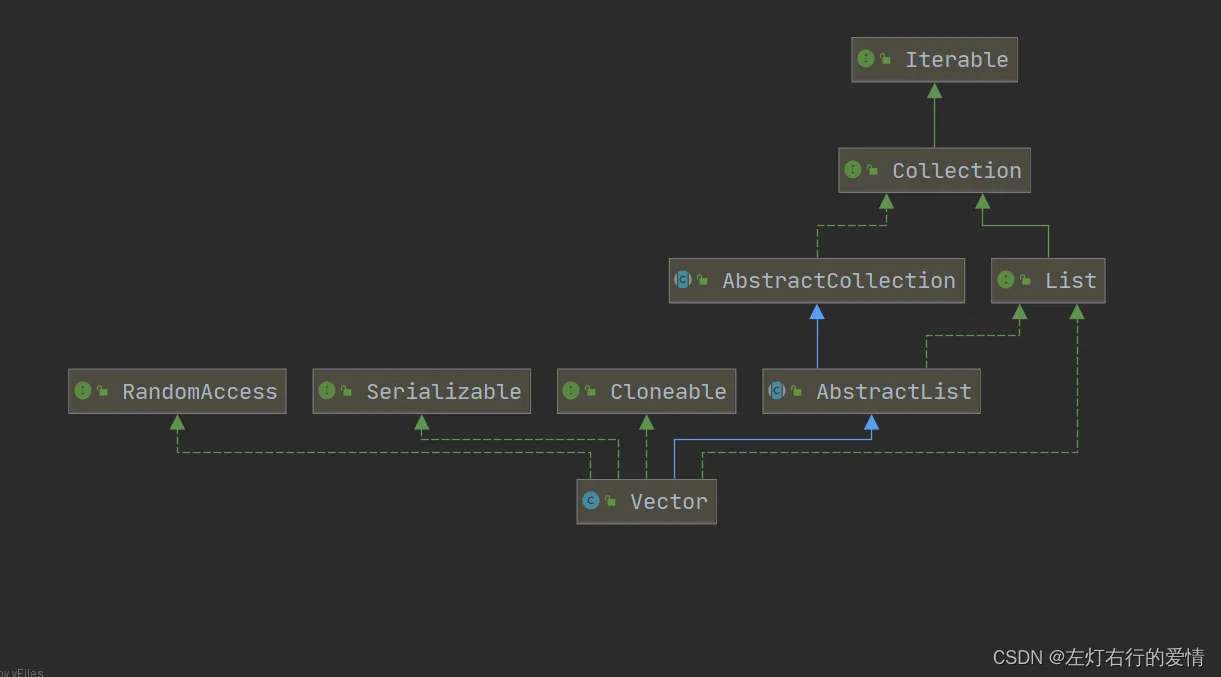
代码实现:
public class Vector<E> extends AbstractList<E> implements List<E>, RandomAccess, Cloneable, java.io.Serializable1.继承了AbstractList,作用是实现了List接口,这个在ArrayList那篇有详细解读
2:实现了RandomAccess接口,提供随机访问功能
3:实现了Cloneable接口,提供
克隆
功能
4:实现了Serializable,支持序列化
三:源码分析
(1):doc解读
/** * The {@code Vector} class implements a growable array of * objects. * Vector类实现了可增长的对象数组 * Like an array, it contains components that can be * accessed using an integer index. * 像数组一样,它包含可以使用索引进行访问组件。 * However, the size of a {@code Vector} can grow or shrink as needed to accommodate adding and removing items after the {@code Vector} has been created.    但是,Vector的大小可以根据需要增大或减小,方便创建后添加或删除元素。 * <p>Each vector tries to optimize storage management by maintaining a * {@code capacity} and a {@code capacityIncrement}.每一个vector尝试维护capacity和capacityIncrement来优化存储管理The {@code capacity} is always at least as large as the vector * size; * capacity始终至少与vector大小一样大 it is usually larger because as components are added to the * vector, the vector's storage increases in chunks the size of * {@code capacityIncrement}.但实际上通常更大,当元素被添加时,vector的存储以块大小添加capacityIncrement。
An application can increase the * capacity of a vector before inserting a large number of * components;程序可以在插入大量组件之前增加vector的容量this reduces the amount of incremental reallocation.这减少了增量重分配的次数
 * <p><a name="fail-fast"> * The iterators returned by this class's {@link #iterator() iterator} and {@link #listIterator(int) listIterator} methods are <em>fail-fast</em></a>: * 构造器返回的迭代器是fail-fast: * if the vector is structurally modified at any time after the iterator iscreated, in any way except through the iterator's own {@link ListIterator#remove() remove} or {@link ListIterator#add(Object) add} methods, the iterator will throw a {@link ConcurrentModificationException}.如果创建迭代器以后的任何时间对vector结构进行修改,除了迭代器自己的remove或add方法以外,迭代器将抛出ConcurrentModificationException异常。Thus, in the face of concurrent modification, the iterator fails quickly and cleanly, rather  than risking arbitrary, non-deterministic behavior at an undetermined time in the future.因此,在并发修改的情况下,迭代器迅速彻底地失败,而不是在将来某个不确定的时间冒着任意,非确定性行为的风险。The {@link Enumeration Enumerations} returned by the {@link #elements() elements} method are <em>not</em> fail-fast.  Enumerations返回elements方法不是fail-fast。 * <p>Note that the fail-fast behavior of an iterator cannot be guaranteed as it is, generally speaking, impossible to make any hard guarantees in the presence of unsynchronized concurrent modification. * 注意!迭代器的fail-fast行为没有保证,一般来说,在有不同步并发修改时,不会做出硬性保证。 *  Fail-fast iterators throw{@codeConcurrentModificationException} on a best-effort basis.    fail-fast迭代器尽力去抛出异常ConcurrentModificationException * Therefore, it would be wrong to write a program that depended on this exception for its correctness:  <i>the fail-fast behavior of iterators should be used only to detect bugs.</i> * 因此,编写设计程序依赖此异常程序确保其正确性是错误的: * 最好用fail-fast去检查bug。 * * <p>As of the Java 2 platform v1.2, this class was retrofitted to * implement the {@link List} interface, making it a member of the * <a href="{@docRoot}/../technotes/guides/collections/index.html"> * Java Collections Framework</a>.  Unlike the new collection * implementations, {@code Vector} is synchronized.  If a thread-safe * implementation is not needed, it is recommended to use {@link * ArrayList} in place of {@code Vector}. * 从Java 2平台v1.2开始,该类被改进以实现List接口,使其成为Java Collections Framework的成员。 与新集合实现不同, Vector是同步的。 如不需要线程安全实现,建议使用ArrayList代替Vector 。 * * @author  Lee Boynton * @author  Jonathan Payne * @see Collection * @see LinkedList * @since   JDK1.0 */
(2):静态变量
/** use serialVersionUID from JDK 1.0.2 for interoperability */ 序列版本号 private static final long serialVersionUID = -2767605614048989439L;(3):成员变量
  /**     * The array buffer into which the components of the vector are     * stored. 存储向量组件的数组缓冲区。     * The capacity of the vector is the length of this array buffer,     * and is at least large enough to contain all the vector's elements.     *向量的容量是这个数组缓冲区的长度,       并且至少大到足以包含所有向量的元素。     * <p>Any array elements following the last element in the Vector are null.Vector中最后一个元素后面的任何数组元素都为空。     *     * @serial     */    protected Object[] elementData;   //保存Vector数据的数组
    /**     * The number of valid components in this {@code Vector} object.  此{@code Vector}对象中有效组件的数量。     * Components {@code elementData[0]} through     * {@code elementData[elementCount-1]} are the actual items.     * 组件elementData[0]到elementData[elementCount-1]是实际数据。     *     * @serial     */    protected int elementCount;   // 实际数据数量
    /**     * The amount by which the capacity of the vector is automatically     * incremented when its size becomes greater than its capacity.  If     * the capacity increment is less than or equal to zero, the capacity     * of the vector is doubled each time it needs to grow.     *当矢量大小超过其容量时,矢量容量自动递增的量。      如果容量增量小于或等于零,则每次需要增长时,矢量的容量加倍。     * @serial     */    protected int capacityIncrement;  // 容量增长系数
(4):构造方法
一共有四个:
第一个:空参,初始容量为10
public Vector() { this(10); }第二个:有参,指定初始容量
/** * Constructs an empty vector with the specified initial capacity and * with its capacity increment equal to zero. * 创建一个指定容量大小的空数组,并且增量为0 * * @param initialCapacity the initial capacity of the vector * @throws IllegalArgumentException if the specified initial capacity * is negative */ public Vector(int initialCapacity) { this(initialCapacity, 0); }第三个:有参,指定初始容量和扩容时的增长系数
/** * Constructs an empty vector with the specified initial capacity and * capacity increment. * 创建一个指定容量大小和增长系数的空Vector * * @param initialCapacity the initial capacity of the vector * @param capacityIncrement the amount by which the capacity is * increased when the vector overflows * @throws IllegalArgumentException if the specified initial capacity * is negative */ public Vector(int initialCapacity, int capacityIncrement) { super(); if (initialCapacity < 0) throw new IllegalArgumentException("Illegal Capacity: "+ initialCapacity); this.elementData = new Object[initialCapacity]; this.capacityIncrement = capacityIncrement; }第四个:有参,根据其他集合创建Vector
public Vector(Collection<? extends E> c) { Object[] a = c.toArray(); elementCount = a.length; if (c.getClass() == ArrayList.class) { elementData = a; } else { elementData = Arrays.copyOf(a, elementCount, Object[].class); } }(5):扩容机制解读:
之前我们已经学习过ArrayList的扩容机制,那么现在再来看Vector就很简单了,它和ArrayList的扩容思想非常类似,只是关键地方有一点点不同而已。
我们先来简单介绍一下这几个方法,最后用一个add方法的例子串起来,学习时注意观察参数。
a:ensureCapacity(int minCapacity)方法:
public synchronized void ensureCapacity(int minCapacity) { if (minCapacity > 0) { modCount++; ensureCapacityHelper(minCapacity); } }目的是确定Vector容量
b: ensureCapacityHelper(int minCapacity)方法: 确定Vector容量的帮助方法
private void ensureCapacityHelper(int minCapacity) { // overflow-conscious code if (minCapacity - elementData.length > 0) 要扩容的大小是否大于现在数组大小 grow(minCapacity); }c:grow(int minCapacity)方法:核心扩容方法
private void grow(int minCapacity) { // overflow-conscious code int oldCapacity = elementData.length; int newCapacity = oldCapacity + ((capacityIncrement > 0) ? capacityIncrement : oldCapacity); 如果容量增量大于0,增新容量为老容量加上容量增量,否则新容量是老容量的两倍 if (newCapacity - minCapacity < 0) 如果此时新容量减去建议最大容量的值还是小于0,那么新容量等于最小容量 newCapacity = minCapacity; if (newCapacity - MAX_ARRAY_SIZE > 0)扩容后大小超过数组最大值 newCapacity = hugeCapacity(minCapacity); elementData = Arrays.copyOf(elementData, newCapacity); }d:
private static int hugeCapacity(int minCapacity) {       if (minCapacity < 0) // overflow           throw new OutOfMemoryError();       return (minCapacity > MAX_ARRAY_SIZE) ?           Integer.MAX_VALUE :           MAX_ARRAY_SIZE;  这里,容量最大值为Max_ARRAY_SIZE,为什么还会返回Integer.MAX_VALUE呢?           如果minCapacity>MAX_ARRAY_SIZE,说明此时容器大小已经为MAX_ARRAY_SIZE.           静态变量中描述了MAX_ARRAY_SIZE = Integer.MAX_VALUE - 8;           一些虚拟机在数组中保留一些标题字,尝试分配更大的数组可能会导致OOM。           注意这里只是可能,所以不如尝试扩容到Integer.MAX_VALUE,可能会成功。
   }
这里扩容不多说了,看过ArrayList再来看这个一看就明白了,下面用add方法举个栗子。
(6):add方法例子
例子代码:
public static void main(String[] args) { Vector vector = new Vector<>(10); for(int i=0;i<10;i++){ vector.add(i); } vector.add(100); System.out.println("vector="+vector); }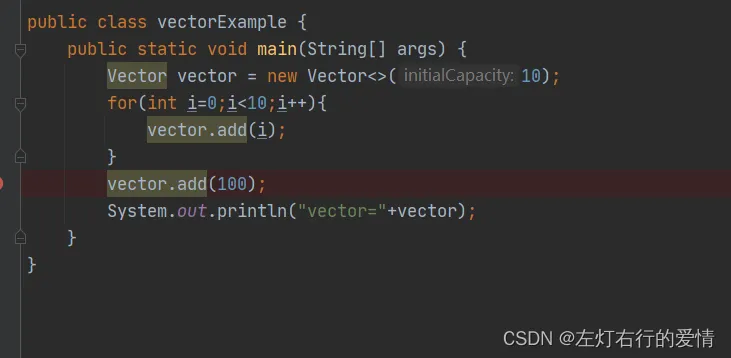
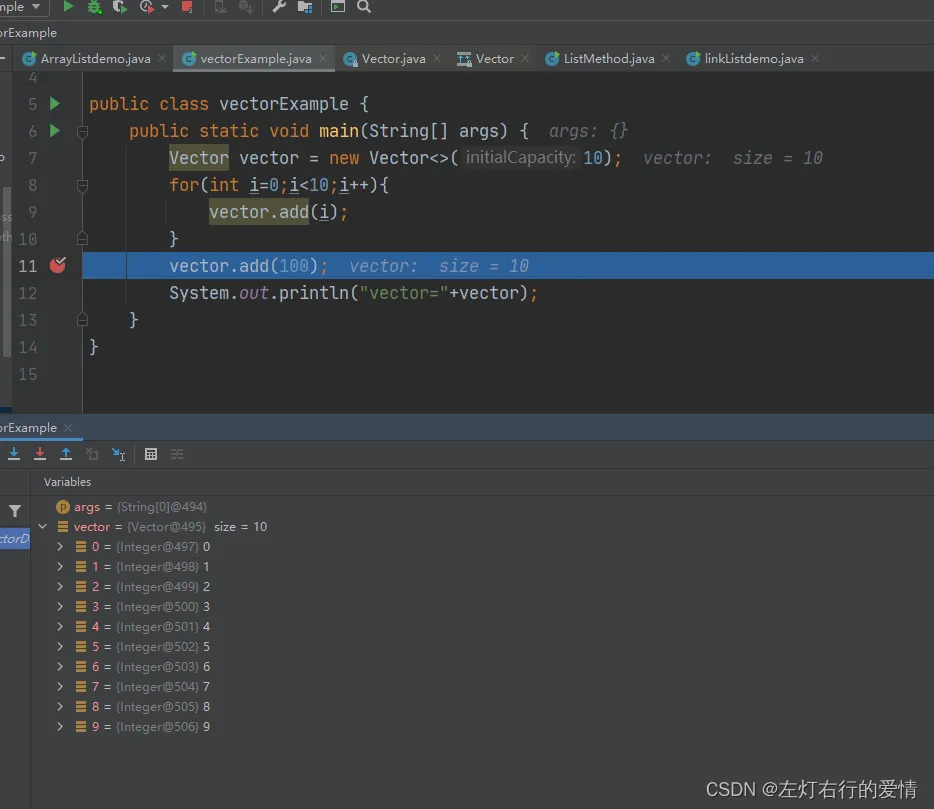
运行到11行,准备进行扩容:
进入add代码里:
public synchronized boolean add(E e) { modCount++; ensureCapacityHelper(elementCount + 1); elementData[elementCount++] = e; return true; }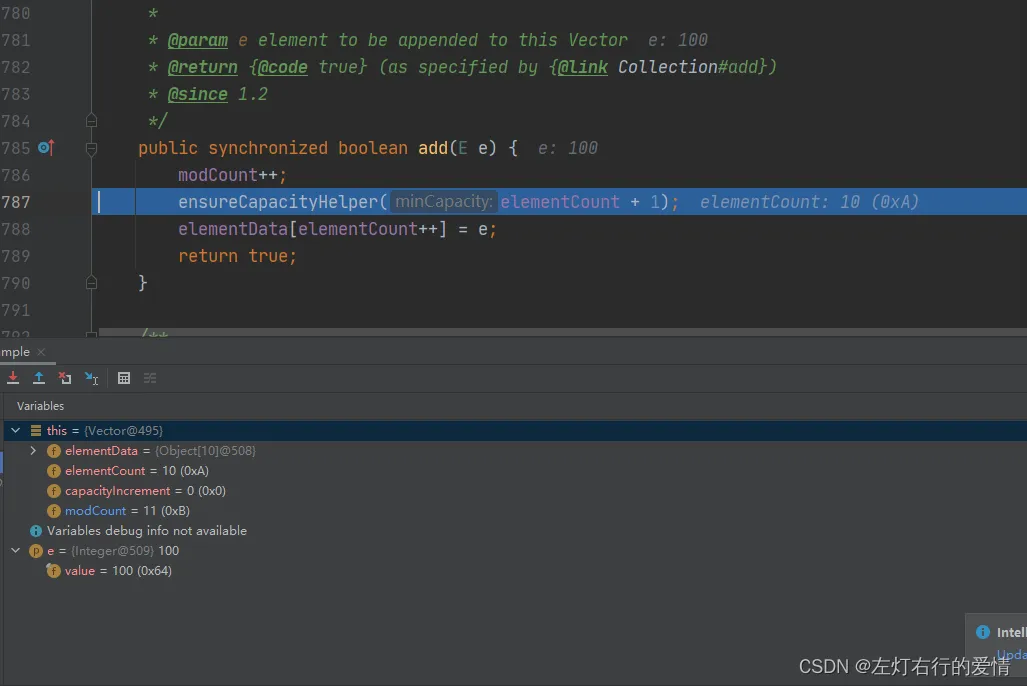
进入ensureCapacityHelper(elementCount + 1)方法:
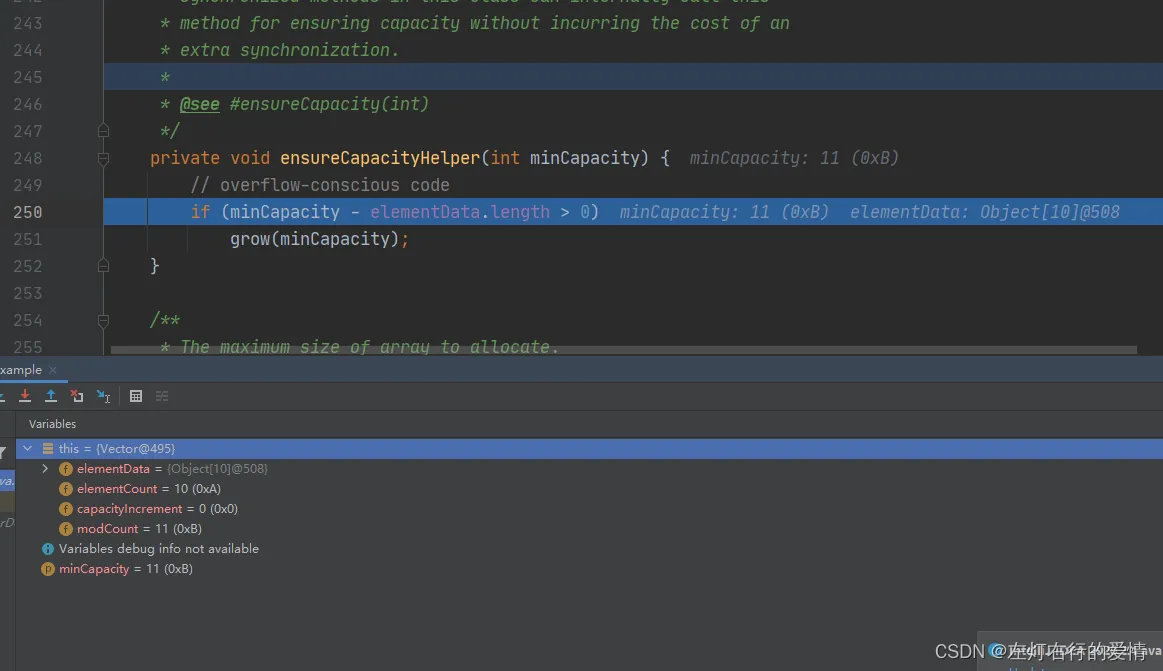
这里进入if判断,minCapacity为11,element.length为10,所以进入if方法块,执行grow方法:
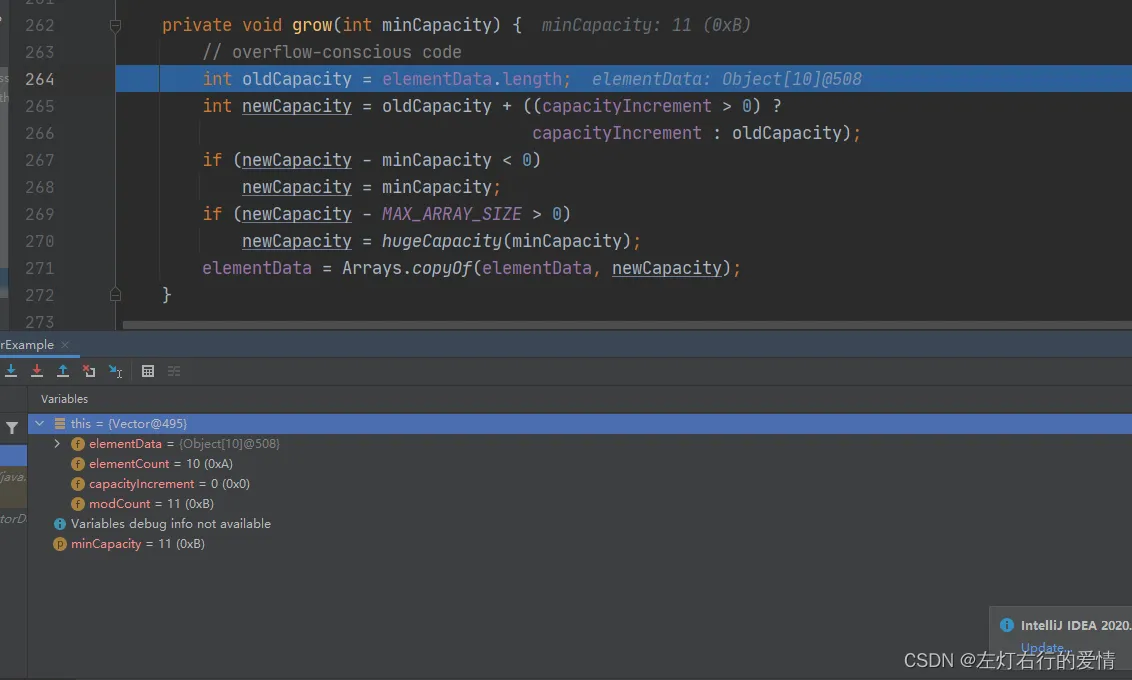
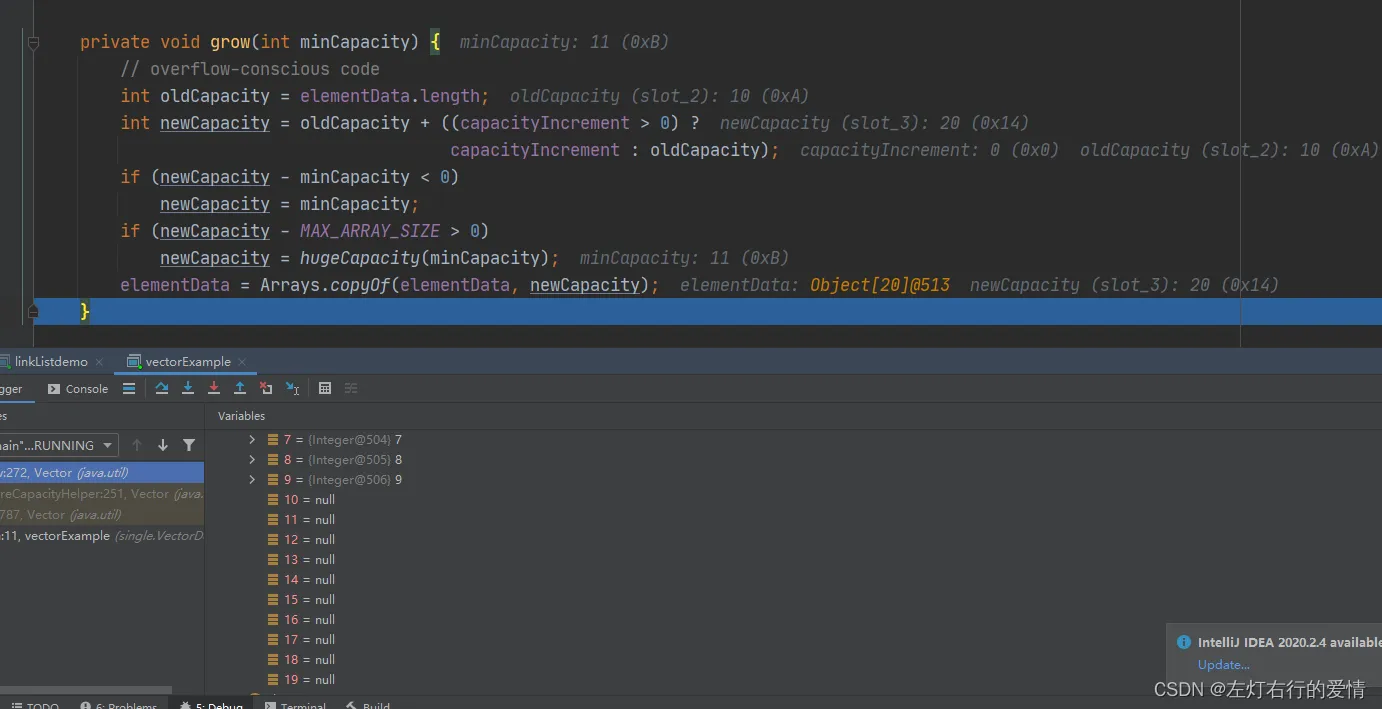
执行完后完成扩容:
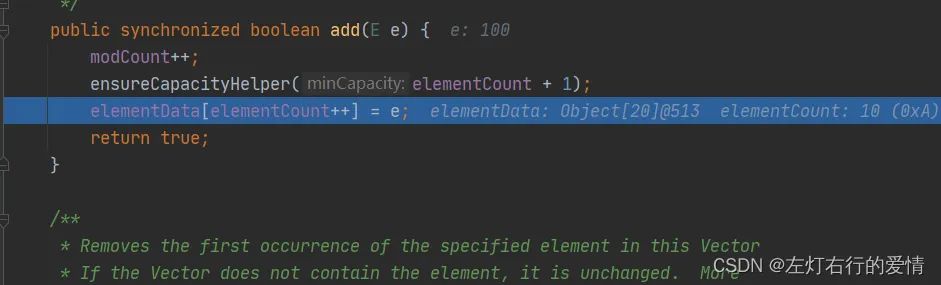
最后完成赋值:
到这里Vector方法就介绍完了,感兴趣自己去debug再看一看。