集合专辑(七):HashTable核心源码解读
原文:CSDN(历史文章导入,当前状态为草稿)
HashTable特点
Section titled “HashTable特点”1:键和值都不允许为null
2:使用方法和HashMap基本一样
3:hashTable是线程安全的,hashMap是线程不安全的
继承结构关系
Section titled “继承结构关系”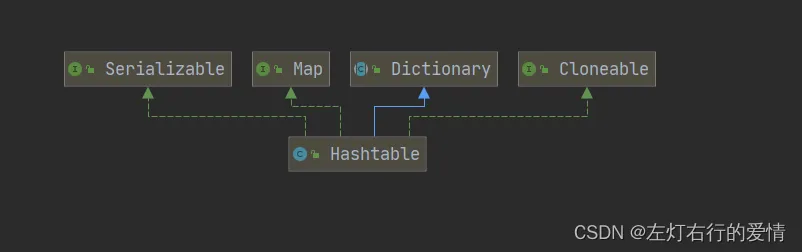
代码实现如下:
public class Hashtable<K,V> extends Dictionary<K,V> implements Map<K,V>, Cloneable, java.io.SerializableDIctionary: 表示键值存储库,操作与Map相似,但是已经过时了,在 java 的后续发展中,逐渐被Map取代了。
/** * This class implements a hash table, which maps keys to values. * 这个类实现了Hash 表,它将key映射到值上 Any non-<code>null</code> object can be used as a key or as a value. *任何非空的对象都可以作为key或者value使用(换言之不允许有null出现) * To successfully store and retrieve objects from a hashtable, the * objects used as keys must implement the <code>hashCode</code> * method and the <code>equals</code> method. <p> *为了成功地从hash表中存储和检索对象,作为key的对象必需实现hashcode和equals方法。 * An instance of <code>Hashtable</code> has two parameters that affect its * performance: <i>initial capacity</i> and <i>load factor</i>. * 一个Hashtable的实力要有两个参数:初始容量和负载因子 * The <i>capacity</i> is the number of <i>buckets</i> in the hash table, and the * <i>initial capacity</i> is simply the capacity at the time the hash table * is created. * 容量Capacity是hash表中桶的数量,初始容量则是在创建hash表的时候同时创建的 * Note that the hash table is <i>open</i>: in the case of a "hash * collision", a single bucket stores multiple entries, which must be searched * sequentially. * 需要注意的是,hash表是开放状态的,在hash冲突情况下,一个桶存储了多个条目,那么必需按顺序对这些条目进行搜索 * * The <i>load factor</i> is a measure of how full the hash table is allowed to get before its capacity is automatically increased. * 负载因子是一个度量hash表在其容量自动增加之前可以达到完整程度。 * * The initial capacity and load factor parameters are merely hints to * the implementation. * 初始容量和负载因子只是对实现的提示 * The exact details as to when and whether the rehash * method is invoked are implementation-dependent.<p> *对于何时以及是否调用rehash扩容方法的确切细节取决于实现。 * Generally, the default load factor (.75) offers a good tradeoff between * time and space costs. * 通常情况下,负载因子默认为0.75,这是在时间和空间成本上的一个平衡。 * Higher values decrease the space overhead but * increase the time cost to look up an entry (which is reflected in most * <tt>Hashtable</tt> operations, including <tt>get</tt> and <tt>put</tt>).<p> *如果这个值太高虽然会降低空间的开销,但是检索的时候会增加时间成本, 这在大多数哈希表的操作中,表现在get和put方法上。 * The initial capacity controls a tradeoff between wasted space and the * need for <code>rehash</code> operations, which are time-consuming. * 初始容量是空间浪费和rehash操作的折衷,因为rehash非常耗时 * No <code>rehash</code> operations will <i>ever</i> occur if the initial * capacity is greater than the maximum number of entries the <tt>Hashtable</tt> will contain divided by its load factor. * 如果初始容量>hashtable将包含的最大条目和负载因子之商,那么不会发生任何rehash操作 * However,setting the initial capacity too high can waste space.<p> *然而,这会造成空间浪费 * If many entries are to be made into a <code>Hashtable</code>, * creating it with a sufficiently large capacity may allow the * entries to be inserted more efficiently than letting it perform * automatic rehashing as needed to grow the table. <p>如果许多条目被创建到hashtable中,创建一个足够大的容量允许这些条目插入,比让这些条目插入之后触发rehash操作更有效率。 * This example creates a hashtable of numbers. It uses the names of * the numbers as keys: * 如下这个例子创建了一个数字的hash表,它使用名称做为数字的key。 * <pre> {@code * Hashtable<String, Integer> numbers * = new Hashtable<String, Integer>(); * numbers.put("one", 1); * numbers.put("two", 2); * numbers.put("three", 3);}</pre> * * <p>To retrieve a number, use the following code: 为了检索一个号码,用如下代码 * <pre> {@code * Integer n = numbers.get("two"); * if (n != null) { * System.out.println("two = " + n); * }}</pre> * * <p>The iterators returned by the <tt>iterator</tt> method of the collections * returned by all of this class's "collection view methods" are * <em>fail-fast</em>: * 由此类所有"集合视图方法" 返回的集合的iterator方法返回的迭代器是fail-fast: * if the Hashtable is structurally modified at any time * after the iterator is created, in any way except through the iterator's own * <tt>remove</tt> method, the iterator will throw a {@link * ConcurrentModificationException}. * 如果在创建迭代器之后的任何时候对Hashtable进行结构修改,除非通过迭代器自己的remove方法,迭代器将抛出ConcurrentModificationException 。 * * Thus, in the face of concurrent * modification, the iterator fails quickly and cleanly, rather than risking * arbitrary, non-deterministic behavior at an undetermined time in the future.因此,在并发修改的情况下,迭代器快速而干净地失败,而不是在未来的未确定时间冒任意,非确定性行为的风险。 * The Enumerations returned by Hashtable's keys and elements methods are * <em>not</em> fail-fast. * Hashtable的keys和elements方法返回的枚举不是快速失败的 * * <p>Note that the fail-fast behavior of an iterator cannot be guaranteed * as it is, generally speaking, impossible to make any hard guarantees in the * presence of unsynchronized concurrent modification. * 请注意,迭代器的快速失败行为无法得到保证,因为一般来说,在存在不同步的并发修改时,不可能做出任何硬性保证。 * Fail-fast iterators * throw <tt>ConcurrentModificationException</tt> on a best-effort basis. * 失败快速迭代器以尽力而为的方式抛出ConcurrentModificationException * Therefore, it would be wrong to write a program that depended on this * exception for its correctness: <i>the fail-fast behavior of iterators * should be used only to detect bugs.</i> * 因此,编写依赖于此异常的程序以确保其正确性是错误的: 迭代器的快速失败行为应该仅用于检测错误。核心内部 类 Entry
Section titled “核心内部 类 Entry”Hashtable与Hashmap相似,Hashtable内部也是采用内部类来实现这些复杂的结构,主要是对键值对的封装
先看这个类的成员变量:
final int hash; //值的hashCode final K key; V value; Entry<K,V> next; //表示下一个节点再来看构造函数:
protected Entry(int hash, K key, V value, Entry<K,V> next) { this.hash = hash; this.key = key; this.value = value; this.next = next; }比较核心的方法:
      public boolean equals(Object o) {            if (!(o instanceof Map.Entry))    //先判断传入对象的类型                return false;            Map.Entry<?,?> e = (Map.Entry<?,?>)o;
            return (key==null ? e.getKey()==null : key.equals(e.getKey())) &&               (value==null ? e.getValue()==null : value.equals(e.getValue()));        }
        public int hashCode() {            return hash ^ Objects.hashCode(value);    //将hash和value的hashCode进行异或运算            在HashMap中是key和value的hashCode进行异或运算,注意区分            代码的结果实际上没有区别,但是hashMap中的hash属性已经被修改了,需要用高位部分混淆            hashMap和HashTable中元素hash属性的计算是有区别的。
Entry全部代码:
private static class Entry<K,V> implements Map.Entry<K,V> {        final int hash;        final K key;        V value;        Entry<K,V> next;
        protected Entry(int hash, K key, V value, Entry<K,V> next) {            this.hash = hash;            this.key =  key;            this.value = value;            this.next = next;        }
        @SuppressWarnings("unchecked")        protected Object clone() {            return new Entry<>(hash, key, value,                                  (next==null ? null : (Entry<K,V>) next.clone()));        }
        // Map.Entry Ops
        public K getKey() {            return key;        }
        public V getValue() {            return value;        }
        public V setValue(V value) {            if (value == null)                throw new NullPointerException();
            V oldValue = this.value;            this.value = value;            return oldValue;        }
        public boolean equals(Object o) {            if (!(o instanceof Map.Entry))                return false;            Map.Entry<?,?> e = (Map.Entry<?,?>)o;
            return (key==null ? e.getKey()==null : key.equals(e.getKey())) &&               (value==null ? e.getValue()==null : value.equals(e.getValue()));        }
        public int hashCode() {            return hash ^ Objects.hashCode(value);        }
public String toString() { return key.toString()+"="+value.toString(); } } /** * The hash table data. */ private transient Entry<?,?>[] table;
/** * The total number of entries in the hash table. */ private transient int count; //当前Hashtable的实际大小
/** * The table is rehashed when its size exceeds this threshold. (The * value of this field is (int)(capacity * loadFactor).) * * @serial */ private int threshold; //扩容阈值 = capacity * loadFactor
/** * The load factor for the hashtable. * * @serial */ private float loadFactor; //负载因子,默认0.75HashMap以及HashTable相关存储元素的数组等属性都是transient修饰,在序列化的时候不会被序列化,而是类自己实现了序列化和反序列化的方法。
不同的虚拟机或者不同操作系统上,hashcode的算法可能会造成相同的值经过hash之后其hashcode不一致。这样就容易造成实际上反序列化之后的HashTable与之前的HashTable不同。
/**     * The number of times this Hashtable has been structurally modified     * Structural modifications are those that change the number of entries in     * the Hashtable or otherwise modify its internal structure (e.g.,     * rehash).  This field is used to make iterators on Collection-views of     * the Hashtable fail-fast.  (See ConcurrentModificationException).     */    private transient int modCount = 0;
    /** use serialVersionUID from JDK 1.0.2 for interoperability */    private static final long serialVersionUID = 1421746759512286392L;
private static final int MAX_ARRAY_SIZE = Integer.MAX_VALUE - 8;
这里对为啥MAX_ARRAY_SIZE不是Integer.MAX_VALUE进行了解释。再某些 jvm 中,数组是需要一些头信息的,因此如果直接将int数组分配为Integer.MAX_VALUE,则会造成OOM。所以这里的长度是Integer.MAX_VALUE - 8;
HashTable的 数据结构
Section titled “HashTable的 数据结构”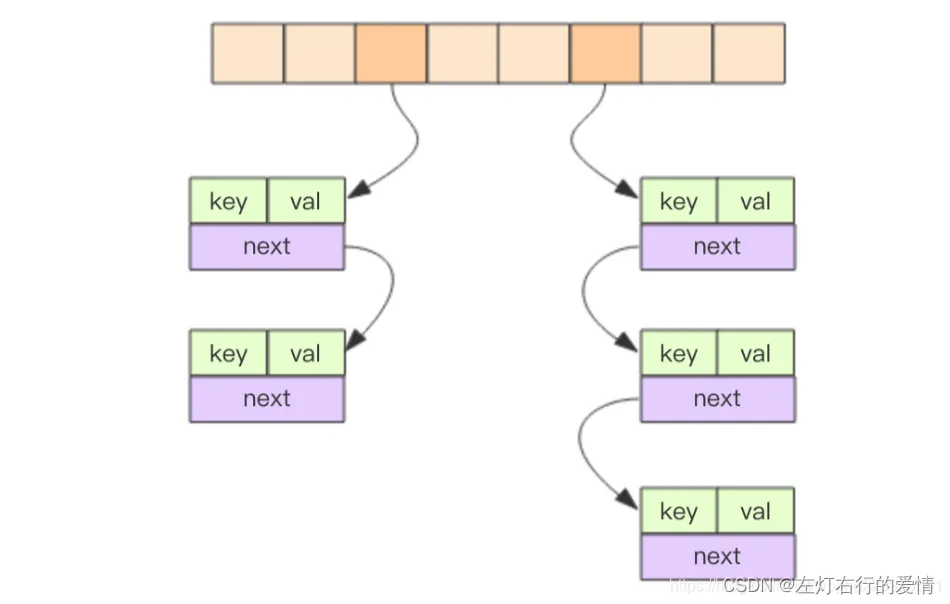
我们学过了HashMap,现在来看HashTable就很简单了,内部构成是通过拉链法实现单向链表。
HashTable的构造函数
Section titled “HashTable的构造函数”构造函数有四种:
1:无参构造
/** * Constructs a new, empty hashtable with a default initial capacity (11) * and load factor (0.75). */ public Hashtable() { this(11, 0.75f); }2:有参(参数为初始容量,负载因子默认为0.75)
public Hashtable(int initialCapacity) { this(initialCapacity, 0.75f); }3:有参(参数是初始容量和负载因子)
  public Hashtable(int initialCapacity, float loadFactor) {        if (initialCapacity < 0)            throw new IllegalArgumentException("Illegal Capacity: "+                                               initialCapacity);        if (loadFactor <= 0 || Float.isNaN(loadFactor))            throw new IllegalArgumentException("Illegal Load: "+loadFactor);
        if (initialCapacity==0)            initialCapacity = 1;        this.loadFactor = loadFactor;        table = new Entry<?,?>[initialCapacity];        threshold = (int)Math.min(initialCapacity * loadFactor, MAX_ARRAY_SIZE + 1);    }
第四种:有参(参数是集合) 根据原有map产生一个新map构造方法
public Hashtable(Map<? extends K, ? extends V> t) { this(Math.max(2*t.size(), 11), 0.75f); putAll(t);//putAll方法是一个同步方法,内部通过遍历,之后对put方法进行调用 }我们以put方法为引子,注意hashtable支持同步:
public synchronized V put(K key, V value) {        // Make sure the value is not null        if (value == null) {     //判断值是否为null            throw new NullPointerException();        }
        // Makes sure the key is not already in the hashtable.        Entry<?,?> tab[] = table;        int hash = key.hashCode();        //计算索引        int index = (hash & 0x7FFFFFFF) % tab.length;       // 0x7FFFFFFF是Integer.Max_VALUE的值,这一步为了防止索引值超出整形范围,然后根据数组长度求余可以将索引控制在数组范围内        @SuppressWarnings("unchecked")        Entry<K,V> entry = (Entry<K,V>)tab[index];        //下面的for循环是用来搜索HashTable是否包含当前要添加的对象,如果包含则直接更新value的值        for(; entry != null ; entry = entry.next) {            if ((entry.hash == hash) && entry.key.equals(key)) {                V old = entry.value;                entry.value = value;                return old;            }        }
        addEntry(hash, key, value, index);//把要添加的对象添加到HashTable        return null;    }
下面进入addEntry方法:
   private void addEntry(int hash, K key, V value, int index) {        modCount++;    //目的是让fail-fast可以监控到
        Entry<?,?> tab[] = table;        if (count >= threshold) {            count元素的数量,如果超过阈值则扩容            // Rehash the table if the threshold is exceeded            rehash(); //扩容方法,该操作会重新创建一个更大的数组,并重新分配所有的数据            tab = table;            hash = key.hashCode();            //重新计算索引            index = (hash & 0x7FFFFFFF) % tab.length;        }
        // Creates the new entry.        @SuppressWarnings("unchecked")        Entry<K,V> e = (Entry<K,V>) tab[index];        //在索引处创建元素,将这个元素添加到链表的末尾        tab[index] = new Entry<>(hash, key, value, e);        count++;    }
我们最后去看扩容方法resize:
  protected void rehash() {        int oldCapacity = table.length;//原始的table容量        Entry<?,?>[] oldMap = table;     //原始的table
        // overflow-conscious code        int newCapacity = (oldCapacity << 1) + 1;   //扩容长度是原来两倍+1        if (newCapacity - MAX_ARRAY_SIZE > 0) {     //如果新容量大于最大值            if (oldCapacity == MAX_ARRAY_SIZE)   //如果旧容量大于最大值                // Keep running with MAX_ARRAY_SIZE buckets                return;            newCapacity = MAX_ARRAY_SIZE;   反之将新容量设置到最大值        }        Entry<?,?>[] newMap = new Entry<?,?>[newCapacity];//创建新的数组
        modCount++;        threshold = (int)Math.min(newCapacity * loadFactor, MAX_ARRAY_SIZE + 1);//重新计算阈值        table = newMap;
        for (int i = oldCapacity ; i-- > 0 ;) {            for (Entry<K,V> old = (Entry<K,V>)oldMap[i] ; old != null ; ) {                Entry<K,V> e = old;                old = old.next;               //注意这个计算槽位的方法                int index = (e.hash & 0x7FFFFFFF) % newCapacity;                e.next = (Entry<K,V>)newMap[index];                newMap[index] = e;            }        }    }
1:因为采用的是&运算,这样一来任何大于0x7FFFFFFF都将只保留0x7FFFFFFF覆盖的低位部分。高位部分会舍去。
2:由于Hashtable的长度不一定满足2的幂,因此其计算槽位不能用位运算。
3:这里直接用%。显然其效率要低于Hashmap中的位运算操作。
4:由于在Hashtable中,rehash并没提供给外部访问,而调用rehash的位置只有addEntry方法。因此这个方法没有加同步关键字。
5:另外HashTable并没提供缩容机制,也不存在HashMap中红黑树和链表互相转换的问题。因此其逻辑要简单得多。
1:HashMap是不支持同步的,不能用于并发场景。而Hashtable的对外的方法都是synchronized的,这样HashTable就能在同步的情况下使用。
2:如果不需要考虑线程安全问题可以使用 HashMap 作为替代,如果需要线程安全的高并发可以使用 ConcurrentHashMap,一般不需要使用 HashTable,所以这个类了解就好= = 。