集合专辑(六):Set接口下HashSet核心源码解读
原文:CSDN(历史文章导入,当前状态为草稿)
HashSet解读
Section titled “HashSet解读”我们之前已经学习了HashMap的核心思想和逻辑,现在再来看HashSet就已经很简单了,因为HashSet的底层就是HashMap= =。
简单看一眼:
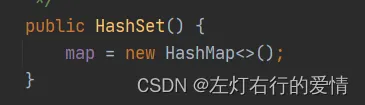
一: 简单介绍
Section titled “一: 简单介绍”1:Hashset实现了set接口,实际上是HashMap,
2:它可以存放null,但是只能存一个。
3:不能有重复的对象,可以达到一个去重的效果。
4:不保证元素是有序的,取决于hash后,再确定索引结果
5:线程不安全,因为HashMap线程不安全,它自然不安全。
HashMap和HashSet的区别
Section titled “HashMap和HashSet的区别”HashSet 的底层实现确实是基于 HashMap 的,但这并不意味着 HashSet 必须提供键值对的存储功能。
HashSet 是 HashMap 的一个“视图”或“封装”,它只使用了 HashMap 的键(key)部分来存储元素,而忽略了值(value)部分。
在 HashSet 的内部实现中,每个元素都被存储为 HashMap 的一个键,而对应的值通常是一个固定的对象(例如,PRESENT),因为这个值对于 HashSet 的功能来说并不重要。HashSet 的主要目的是提供一个不包含重复元素的集合,因此它只需要利用 HashMap 的键的唯一性特性。
HashSet 提供了一个简洁的接口来存储不重复的元素集合,而隐藏了其底层实现的复杂性。我们不需要关心键值对的概念,只需要将元素添加到集合中,并确保它们的唯一性。
简言之,HashSet使用HashMap作为底层实现是一种设计上的选择,旨在重用代码,提高性能和简化实现,同时为用户提供了一个专注于元素唯一性的简洁接口.
二:继承图&结构
Section titled “二:继承图&结构”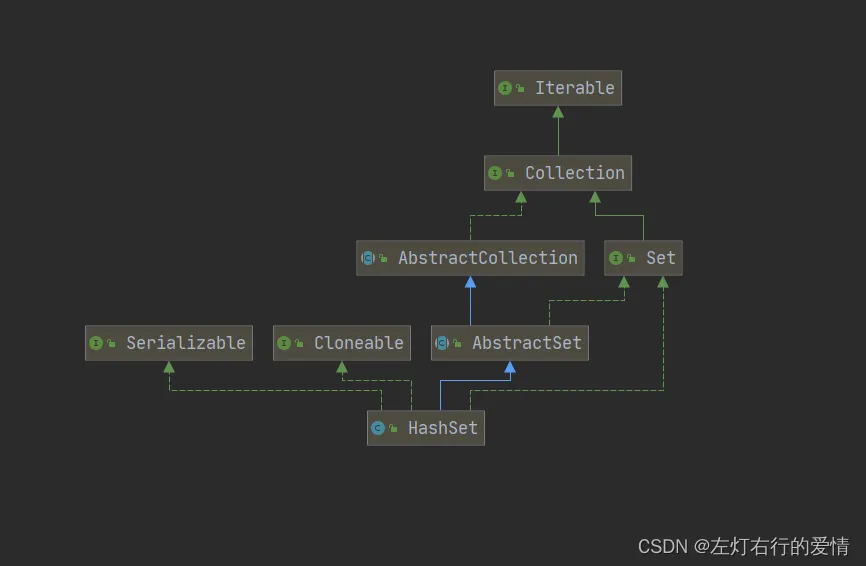
代码实现如下:
public class HashSet<E> extends AbstractSet<E> implements Set<E>, Cloneable, java.io.Serializable1:AbstractSet:此
类
提供了Set接口的骨干实现,从而最大限度地减少了实现此接口所需的工作。
2:Cloneable:提供可拷贝功能
3:Serializable: 提供可序列化功能。
在这里的描述都不细致,因为在ArrayList那节都已经解读过了,感兴趣可以去看看前面的ArrayList解读。
三:源码分析
Section titled “三:源码分析”javaDoc分析
Section titled “javaDoc分析”/** * This class implements the <tt>Set</tt> interface, backed by a hash table * (actually a <tt>HashMap</tt> instance). * 这个类实现了set接口,并且有hash表的支持(实际上是hashMap) * It makes no guarantees as to the iteration order of the set; in particular, it does not guarantee that the order will remain constant over time.它不保证集合的迭代顺序,尤其是,不保证顺序随时间不变 * This class permits the <tt>null</tt>element. * 这个类允许null元素出现 * * <p>This class offers constant time performance for the basic operations * (<tt>add</tt>, <tt>remove</tt>, <tt>contains</tt> and <tt>size</tt>), * assuming the hash function disperses the elements properly among the * buckets. * 这个类提供的操作(add,remove,contains,size)都是常数级时间复杂度, * 假定hash函数将分散元素到桶中 * * Iterating over this set requires time proportional to the sum of * the <tt>HashSet</tt> instance's size (the number of elements) plus the * "capacity" of the backing <tt>HashMap</tt> instance (the number of * buckets). * 迭代此集合需要的时间与hashSet元素数量加上后备HashMap的容量(桶数)之和成正比例。 * * Thus, it's very important not to set the initial capacity too * high (or the load factor too low) if iteration performance is important. *所以,为了迭代的性能,不要将初始容量设置的过高(或负载因子太低)非常重要。 * <p><strong>Note that this implementation is not synchronized.</strong> * 注意,此实现不同步 * If multiple threads access a hash set concurrently, and at least one of * the threads modifies the set, it <i>must</i> be synchronized externally. * 如果多个线程同时访问,并且至少有一个线程修改了该集合,则必需在外部进行同步。 * This is typically accomplished by synchronizing on some object that * naturally encapsulates the set. *这通常在自然封装集合的某个对象上进行同步来实现 * If no such object exists, the set should be "wrapped" using the * {@link Collections#synchronizedSet Collections.synchronizedSet} * method. * 如果不存在此类对象,则应使用Collections.synchronizedSet方法“包装”该集合 。 * This is best done at creation time, to prevent accidental * unsynchronized access to the set:<pre> * Set s = Collections.synchronizedSet(new HashSet(...));</pre> *这最好在创建时完成,以防止对集合的意外不同步访问: Set s = Collections.synchronizedSet(new HashSet(...));
* <p>The iterators returned by this class's <tt>iterator</tt> method are * <i>fail-fast</i>: if the set is modified at any time after the iterator is * created, in any way except through the iterator's own <tt>remove</tt> * method, the Iterator throws a {@link ConcurrentModificationException}. * 此类的iterator方法返回的迭代器是快速失败的 :如果在创建迭代器之后的任何时间修改该集,除了通过迭代器自己的remove方法之外,迭代器抛出ConcurrentModificationException 。 * Thus, in the face of concurrent modification, the iterator fails quickly * and cleanly, rather than risking arbitrary, non-deterministic behavior at * an undetermined time in the future. *因此,在并发修改的情况下,迭代器快速而干净地失败,而不是在未来的未确定时间冒任意,非确定性行为的风险。 * <p>Note that the fail-fast behavior of an iterator cannot be guaranteed * as it is, generally speaking, impossible to make any hard guarantees in the * presence of unsynchronized concurrent modification. * 请注意,迭代器的快速失败行为无法得到保证,因为一般来说,在存在不同步的并发修改时,不可能做出任何硬性保证。 * Fail-fast iterators throw <tt>ConcurrentModificationException</tt> on a best * -effort basis. * 失败快速迭代器以尽力而为的方式抛出ConcurrentModificationException 。 * * Therefore, it would be wrong to write a program that depended on this * exception for its correctness: <i>the fail-fast behavior of iterators * should be used only to detect bugs.</i> *因此,编写依赖于此异常的程序以确保其正确性是错误的: 迭代器的快速失败行为应该仅用于检测错误。HashSet的构造方法有四种:
1:无参构造
/** * Constructs a new, empty set; the backing <tt>HashMap</tt> instance has * default initial capacity (16) and load factor (0.75). */ public HashSet() { map = new HashMap<>(); }成员变量&&静态变量
Section titled “成员变量&&静态变量”成员变量:
private transient HashMap<E,Object> map; //底层采用HashMap存储静态变量:
static final long serialVersionUID = -5024744406713321676L;//序列号
 private static final Object PRESENT = new Object(); 这个非常重要,因为HashMap接收的是键值对,而HashSet是单列只有值,所以这里HashSet采用的方法是把值存在HashMap键的位置,而值则填充一个静态变量present。
有参构造(参数是集合)
Section titled “有参构造(参数是集合)” /** * Constructs a new set containing the elements in the specified * collection. The <tt>HashMap</tt> is created with default load factor * (0.75) and an initial capacity sufficient to contain the elements in * the specified collection. * 构造一个包含指定集合中元素的新集合。 * HashMap使用默认加载因子(0.75)创建,初始容量足以包含指定集合中的元素。 * * @param c the collection whose elements are to be placed into this set * @throws NullPointerException if the specified collection is null */ public HashSet(Collection<? extends E> c) { map = new HashMap<>(Math.max((int) (c.size()/.75f) + 1, 16)); addAll(c); } 这里Math.max((int) (c.size()/.75f)是给HashMap足够的存储空间。3:有参构造(参数是初始容量和负载因子)
/** * Constructs a new, empty set; the backing <tt>HashMap</tt> instance has * the specified initial capacity and the specified load factor. * 构造一个新的空集; 依赖HashMap实例具有指定的初始容量和指定的加载因子。 * * @param initialCapacity the initial capacity of the hash map * @param loadFactor the load factor of the hash map * @throws IllegalArgumentException if the initial capacity is less * than zero, or if the load factor is nonpositive */ public HashSet(int initialCapacity, float loadFactor) { map = new HashMap<>(initialCapacity, loadFactor); }4:有参(参数只有初始容量)
public HashSet(int initialCapacity) { map = new HashMap<>(initialCapacity); }(3): 方法举例
因为HashSet就是依赖HashMap,所以它的底层就是HashMap,你可以把HashSet看做一个人偶,背后操作它的是HashMap。
以add方法举例
浅看一眼源码:
public boolean add(E e) { return map.put(e, PRESENT)==null; }所以看到这我们明白了,HashMap会了,HashSet自然就会了,不多说了。
后面我们会更加深入去探讨集合,目前了解这么多已经足够了。