集合专辑(八):HashMap的子类LinkedHashMap核心源码解读
原文:CSDN(历史文章导入,当前状态为草稿)
在我们刚学习LInkedList的时候我们知道,LinkedList实际上性能不会比ArrayList高很多,因为LinkedList只有在前向插入的时候性能才会比ArrayList高。
LinkedList虽然在remove和insert操作不需要拷贝数据,但是寻址需要时间(从链表中找到需要操作的节点),只能挨个遍历。
那么有没有一种数据结构,能够把查询链表某一个元素所需要的时间复杂度O(n)变为O(1)呢?
LInkedHashMap就是这样的一种数据结构,综合了HashMap和链表的有点,虽然数据结构相对来说比较复杂,但是在某些场景下,性能要更好一些。
继承结构关系
Section titled “继承结构关系”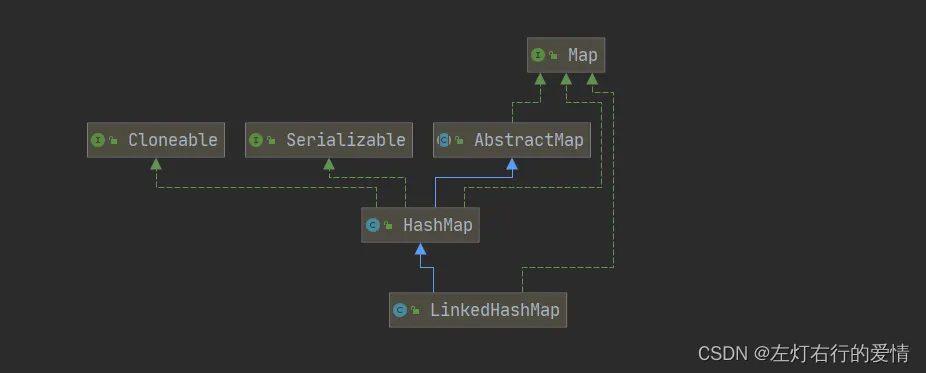
代码实现:
public class LinkedHashMap<K,V> extends HashMap<K,V> implements Map<K,V>这个我觉得不必多说了。
/** * <p>Hash table and linked list implementation of the <tt>Map</tt> interface, * with predictable iteration order. * Map接口的hash表和链表实现,具有可预测的迭代顺序 * * This implementation differs from <tt>HashMap</tt> in that it maintains a doubly-linked list running through all of its entries. * 此实现与hashMap不同之处在于它维护了一个贯穿其所有entry的双向列表 *  This linked list defines the iteration ordering,which is normally the order in which keys were inserted into the map (<i>insertion-order</i>). * 这个链表定义了迭代排序,通常是通过键插入映射的顺序(插入顺序) *  Note that insertion order is not affected if a key is <i>re-inserted</i> into the map.  注意,如果将键重新插入,不会影响插入顺序 * (A key <tt>k</tt> is reinserted into a map <tt>m</tt> if <tt>m.put(k, v)</tt> is invoked when <tt>m.containsKey(k)</tt> would return <tt>true</tt> immediately prior tothe invocation.) *一个键k重新插入map集合m,其迭代顺序不会改变, * <p>This implementation spares its clients from the unspecified, generally * chaotic ordering provided by {@link HashMap} (and {@link Hashtable}), * without incurring the increased cost associated with {@link TreeMap}. * 这个实现避免了用户使用hashMap和hashtable提供的未指定的,混乱的排序,同时又不会像TreeMap那样为了达到有序而带来额外的开销。 * It can be used to produce a copy of a map that has the same order as the * original, regardless of the original map's implementation: * 它可以生成一些具有原始顺序的副本,在实现过程中完全不考虑原始的实现 * <pre> *     void foo(Map m) { *         Map copy = new LinkedHashMap(m); *         ... *     } * </pre> * This technique is particularly useful if a module takes a map on input, * copies it, and later returns results whose order is determined by that of * the copy.  (Clients generally appreciate having things returned in the same * order they were presented.) *如果一个模块输入的时候获取一个map,然后返回结果,其顺序由复制时的顺序而决定,这种技术非常有用 (客户通常喜欢按提交的顺序返回物品)
 * <p>A special {@link #LinkedHashMap(int,float,boolean) constructor} is * provided to create a linked hash map whose order of iteration is the order * in which its entries were last accessed, from least-recently accessed to * most-recently (<i>access-order</i>). * 特殊的构造函数LinkedHashMap(int,float,boolean) 提供创建迭代顺序为上次访问顺序的链表hash结构, * This kind of map is well-suited to building LRU caches. * 这种map能很好的构建LRU缓存 *  Invoking the {@code put}, {@code putIfAbsent}, {@code get}, {@code getOrDefault}, {@code compute}, {@code computeIfAbsent}, {@code computeIfPresent}, or {@code merge} methods results in an access to the corresponding entry (assuming it exists after the invocation completes). * 调用put、  get、getOrDefault、compute、computeIfPresent、merge等方法将导致对应条目的访问(假设它在调用完成后存在)。The {@code replace} methods only result in an access of the entry if the value is replaced.仅仅在值会替换的时候,replace才会访问条目
 The {@code putAll} method generates one entry access for each mapping in the specified map, in the order that  key-value mappings are provided by the specified map's entry set iterator. putAll方法为指定映射中的每个映射生成一个条目访问,顺序是指映射的条目和迭代器提供的键值映射 <i>No other methods generate entry accesses.</i>  * 没有其他的访问生成入口要访问。 In particular, operations on collection-views do <i>not</i> affect the order of iteration of the backing map. 通常情况下,对集合视图操作不会影响备份映射的迭代顺序
 * <p>The {@link #removeEldestEntry(Map.Entry)} method may be overridden to impose a policy for removing stale mappings automatically when new mappings are added to the map. * removeEldestEntry(Map.Entry)方法可能会被重写,以便向Map中添加新的映射时强制执行一个策略,以便自动删除过时的映射。 * * <p>This class provides all of the optional <tt>Map</tt> operations, and * permits null elements. * 此类提供所有可选的map操作,并允许null元素。
 * Like <tt>HashMap</tt>, it provides constant-time performance for the basic operations (<tt>add</tt>, <tt>contains</tt> and <tt>remove</tt>), assuming the hash function disperses elements* properly among the buckets. * 像HashMap,它提供了操作有恒定常数级时间的表现(add,contains,remove),假设hash有足够的离散,元素都分布在各个桶中 * Performance is likely to be just slightly below that of <tt>HashMap</tt>, due to the added expense of maintaining the linked list, with one exception: * 性能只比HashMap略低,比链表时间略高。但有一个情况例外: * Iteration over the collection-views of a <tt>LinkedHashMap</tt> requires time proportional to the <i>size</i>of the map, regardless of its capacity. * 对于LinkedHashMap的集合视图进行迭代所需的时间与映射大小成正比,无论容量如何。 * Iteration over a <tt>HashMap</tt> is likely to be more expensive, requiring time proportional to its <i>capacity</i>. *在HashMap上迭代的性能可能比较低,需要的时间与其桶的数量有关。 * <p>A linked hash map has two parameters that affect its performance: * <i>initial capacity</i> and <i>load factor</i>. * LInkedHashMap有两个参数会影响性能:初始容量和负载因子 * They are defined precisely as for <tt>HashMap</tt>. * 他们在HashMap中有精确的定义。 *  Note, however, that the penalty for choosing an excessively high value for initial capacity is less severe for this class than for <tt>HashMap</tt>, as iteration times for this class are unaffected  by capacity. * 但是注意,对于LinkedHashMap来说,一旦初始容量选择过高带来的弊端比HashMap要轻,因为LinkedHashMap的迭代次数不受容量的影响。 * * <p><strong>Note that this implementation is not synchronized.</strong> * LinkedHashMap是不同步的 * If multiple threads access a linked hash map concurrently, and at least * one of the threads modifies the map structurally, it <em>must</em> be * synchronized externally. * 如果多个线程需要同时访问,并且至少有一个线程在结构上对其进行了修改,则它必须在外部同步。 * This is typically accomplished by synchronizing on some object that naturally encapsulates the map. *这通常是在一些自然封装的映射的对象上来同步实现的。 * If no such object exists, the map should be "wrapped" using the * {@link Collections#synchronizedMap Collections.synchronizedMap} * method.  This is best done at creation time, to prevent accidental * unsynchronized access to the map:<pre> * *   Map m = Collections.synchronizedMap(new LinkedHashMap(...));</pre> *如果没有这样的对象,那么应该用Collections.synchronizedMap将这个对象包裹。最好在对象创建的时候就完成,以免造成非同步的访问。Map m = Collections.synchronizedMap(new LinkedHashMap(...));
 * A structural modification is any operation that adds or deletes one or more * mappings or, in the case of access-ordered linked hash maps, affects * iteration order. * 结构修改时添加或者删除一个或者多个操作的任何映射操作。或者在访问顺序LinkedHashMap的情况下,影响其迭代顺序的任何操作。 *  In insertion-ordered linked hash maps, merely changing the value associated with a key that is already contained in the map is not a structural modification. * 在插入顺序的LinkedHashMap中,仅仅是更改map中已包含的key相关的值不是结构修改。 * <strong>In access-ordered linked hash maps, merely querying the map with <tt>get</tt> is a structural modification. </strong>) *在有访问顺序的linkedHashmap中,仅仅使用get进行查询也是一种结构修改。 * <p>The iterators returned by the <tt>iterator</tt> method of the collections * returned by all of this class's collection view methods are <em>fail-fast</em>: * if the map is structurally modified at any time after the iterator is created, in any way except through the iterator's own <tt>remove</tt> method, the iterator will throw a {@link ConcurrentModificationException}. * 类的所有集合视图方法返回的collections的iterator方法都是fail-fast的。 * 如果迭代器在创建之后任何时候被修改,以任何方式(除了迭代器自己的remove)对map进行修改。迭代器将抛出ConcurrentModificationException。 *  Thus, in the face of concurrent * modification, the iterator fails quickly and cleanly, rather than risking * arbitrary, non-deterministic behavior at an undetermined time in the future. *因此在并发修改的情况下,迭代器会快速的失败,而不是将来在某个不确定的时间,冒着任意的的不确定的风险。 * <p>Note that the fail-fast behavior of an iterator cannot be guaranteed * as it is, generally speaking, impossible to make any hard guarantees in the * presence of unsynchronized concurrent modification. * 需要注意的是迭代器的fail-fast行为不能得到保证,因为一般来说,存在不同步的并发修改时不可能做出任何保证。 *  Fail-fast iterators * throw <tt>ConcurrentModificationException</tt> on a best-effort basis. * fail-fast机制尽力的抛出了ConcurrentModificationException, * Therefore, it would be wrong to write a program that depended on this * exception for its correctness:   <i>the fail-fast behavior of iterators * should be used only to detect bugs.</i> *因此在编写一个依赖于这个异常来保证其正确性的程序是错误的。迭代器的fail-fast机制只用于检测bug。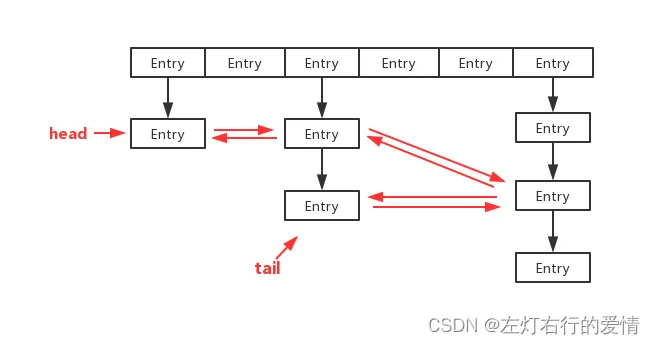
我们需要注意,LinkedHashMap实际上是一个Entry节点链入双向链表的HashMap,通过维护一个Entry的双向链表,保证了插入Entry中顺序
Entry内部类
Section titled “Entry内部类”(1):Entry的继承结构
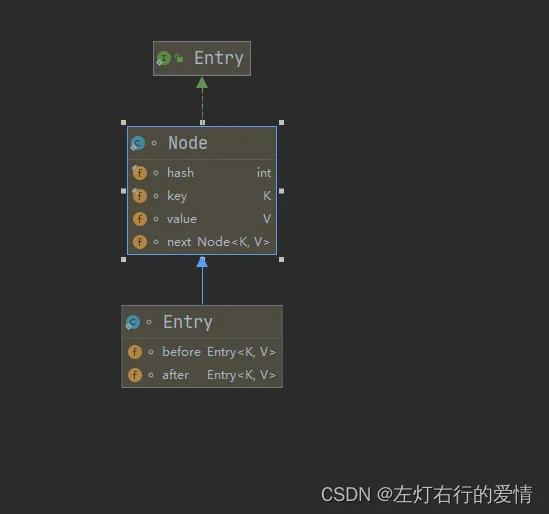
代码实现:
/** * HashMap.Node subclass for normal LinkedHashMap entries. */ static class Entry<K,V> extends HashMap.Node<K,V> { Entry<K,V> before, after; Entry(int hash, K key, V value, Node<K,V> next) { super(hash, key, value, next); } }Entry主要作用是实现对Node节点的链表化。
构建一个新的双向链表来作为HashMap的扩展。
之后LinkedHashMap可以作为链表使用。
Entry抓哟增加了before和after两个指针,以将HashMap的全部Entry转成成双向链表
成员变量&&静态变量
Section titled “成员变量&&静态变量”成员变量:
 /**     * The head (eldest) of the doubly linked list.     */    transient LinkedHashMap.Entry<K,V> head;双向链表的头部
    /**     * The tail (youngest) of the doubly linked list.     */    transient LinkedHashMap.Entry<K,V> tail;双向链表的尾部
    /**     * The iteration ordering method for this linked hash map: <tt>true</tt>     * for access-order, <tt>false</tt> for insertion-order.     *     * @serial     */    final boolean accessOrder;链表的迭代顺序,true---按访问顺序(最近访问的元素将被移动到head),false---插入顺序
这三个变量都用了translent修饰。
静态变量:
private static final long serialVersionUID = 3801124242820219131L; 序列号五种构造方法:
1:无参构造
public LinkedHashMap() { super(); //使用默认初始大小和负载因子0.75 accessOrder = false; //链表的迭代顺序是插入迭代 }super:
public HashMap() { this.loadFactor = DEFAULT_LOAD_FACTOR; // all other fields defaulted }2:有参构造(参数为初始容量)
public LinkedHashMap(int initialCapacity) { super(initialCapacity); accessOrder = false; } /** * Constructs an empty <tt>HashMap</tt> with the specified initial * capacity and the default load factor (0.75). * * @param initialCapacity the initial capacity. * @throws IllegalArgumentException if the initial capacity is negative. */ public HashMap(int initialCapacity) { this(initialCapacity, DEFAULT_LOAD_FACTOR); }3:有参构造(参数为初始容量和负载因子)
public LinkedHashMap(int initialCapacity, float loadFactor) { super(initialCapacity, loadFactor); accessOrder = false; } public HashMap(int initialCapacity, float loadFactor) { if (initialCapacity < 0) throw new IllegalArgumentException("Illegal initial capacity: " + initialCapacity); if (initialCapacity > MAXIMUM_CAPACITY) initialCapacity = MAXIMUM_CAPACITY; if (loadFactor <= 0 || Float.isNaN(loadFactor)) throw new IllegalArgumentException("Illegal load factor: " + loadFactor); this.loadFactor = loadFactor; this.threshold = tableSizeFor(initialCapacity); }4:有参构造(参数为集合)
public LinkedHashMap(Map<? extends K, ? extends V> m) { super(); accessOrder = false; putMapEntries(m, false); } super为: public HashMap() { this.loadFactor = DEFAULT_LOAD_FACTOR; // all other fields defaulted }5:有参构造(参数为初始容量,负载因子,迭代顺序)
public LinkedHashMap(int initialCapacity, float loadFactor, boolean accessOrder) { super(initialCapacity, loadFactor); this.accessOrder = accessOrder; }LinkedHashMap存取
Section titled “LinkedHashMap存取”我们先来看存储
你在LinkedHashMap的源码中找不到put方法,因为它完美继承了HashMap的put(Key,Value)的方法
其源码:
public V put(K key, V value) { return putVal(hash(key), key, value, false, true); }核心方法是putVal:
* @param hash hash for key // hash值 * @param key the key //key值 * @param value the value to put // value值 * @param onlyIfAbsent if true, don't change existing value /这里onlyIfAbsent为false即在key值相同的时候,用新的value值替换原始值,如果为ture,则不改变value值 * @param evict if false, the table is in creation mode. 表是否在创建模式,如果为false,则表是在创建模式。 * @return previous value, or null if none */ final V putVal(int hash, K key, V value, boolean onlyIfAbsent, boolean evict) { Node<K,V>[] tab; Node<K,V> p; int n, i; //如果当前HashMap的table数组还未定义或者还没有初始化长度,则先通过扩容resize()进行扩容,并返回扩容后的长度n。 if ((tab = table) == null || (n = tab.length) == 0) n = (tab = resize()).length;通过数组的长度与hash值做&运算,如果为空则当前创建的节点就是根节点 if ((p = tab[i = (n - 1) & hash]) == null) tab[i] = newNode(hash, key, value, null);//若该位置已经有元素了,我们需要进行一些操作 else { Node<K,V> e; K k; //如果插入的key与原来的key相同,则进行替换 if (p.hash == hash && ((k = p.key) == key || (key != null && key.equals(k)))) e = p; //如果key不同的情况下,判断当前Node是否为TreeNode,如果是则执行putTreeVal将新的元素插入到红黑树上 else if (p instanceof TreeNode) e = ((TreeNode<K,V>)p).putTreeVal(this, tab, hash, key, value); //如果不是TreeNode,则进行链表的遍历 else { for (int binCount = 0; ; ++binCount) { //注意这里循环没有终止条件 //如果在链表最后一个节点之后没有找到相同的元素,则直接new Node插入 if ((e = p.next) == null) { p.next = newNode(hash, key, value, null); //如果此时binCount从0开始超过了8(包含8),转为红黑树(但这里并不是直接转,因为进到treeifyBin还有一个判断是HashMap容量是否大于64,HashMap从链表转化为红黑树一定是两个条件都符合) if (binCount >= TREEIFY_THRESHOLD - 1) // -1 for 1st treeifyBin(tab, hash); break; } //如果在最后一个链表节点之前找到key值相同的节点(上面那个是通过数组的下标,和这个不相同),则替换 if (e.hash == hash && ((k = e.key) == key || (key != null && key.equals(k)))) break; p = e; } }如果上面我们找到了对应key的的Node节点,如果不存在上面会新建节点,这里对e的值数据进行处理 if (e != null) { // existing mapping for key V oldValue = e.value; if (!onlyIfAbsent || oldValue == null) e.value = value; afterNodeAccess(e); return oldValue; } } ++modCount; //判断临界值,是否扩容。 if (++size > threshold) resize(); //扩容方法 afterNodeInsertion(evict); //插入之后的平衡操作 return null; }我们回头去看HashMap中的put方法,可以发现,putVal是final修饰的,这意味着LinkedHashMap无法重写这个方法。
由于putVal中全部都是对HashMap是否需要树化的操作,HashMap是否考虑到put之后链表的关系如何维护呢?
实际上在HashMap中的putVal中,已经预留了后处理的方法:
// Callbacks to allow LinkedHashMap post-actions void afterNodeAccess(Node<K,V> p) { } //访问 void afterNodeInsertion(boolean evict) { } //插入 void afterNodeRemoval(Node<K,V> p) { } //删除这三个方法在HashMap中都是空实现,为了预留给LinkedHashMap进行使用的。
我们可以称他们为维护链表的操作,接下来我们一个个进行分析:
1:afterNodeAccess:
//在节点被访问后根据accessOrder判断是否需要调整链表顺序,如果accessOrder为true,那么被access的节点就要移动到tail(尾部,也就是最新的节点) void afterNodeAccess(Node<K,V> e) { / / move node to last LinkedHashMap.Entry<K,V> last; //链表尾节点 //判断当前accessOrder是否为true,且当前节点不为尾结点 if (accessOrder && (last = tail) != e) { LinkedHashMap.Entry<K,V> p = (LinkedHashMap.Entry<K,V>)e, //p指向待删除元素 b = p.before, a = p.after; // 将p的after置为null p.after = null; if (b == null) //如果e前面没有节点,将e后面的节点置为首节点 head = a; else //如果e前面有节点,将e前面节点的后置指针指向e后面的节点 b.after = a; if (a != null) //如果e后面有节点,将后面节点的前置节点指向e前面节点 a.before = b; else //如果e后面没有节点,将e前面节点置为尾结点 last = b; if (last == null) 将p放在尾部 head = p; else { p.before = last; last.after = p; } tail = p; ++modCount; } }2:afterNodeInsertion
void afterNodeInsertion(boolean evict) { // possibly remove eldest LinkedHashMap.Entry<K,V> first; if (evict && (first = head) != null && removeEldestEntry(first)) { K key = first.key; removeNode(hash(key), key, null, false, true); } } protected boolean removeEldestEntry(Map.Entry<K,V> eldest) { return false; }这个方法目的是删除最老的节点(head节点),但是这个方法默认是不执行的,留给我们自己扩展,因为removeEldestEntry默认为false。
3:afterNodeRemoval
void afterNodeRemoval(Node<K,V> e) { // unlink LinkedHashMap.Entry<K,V> p = (LinkedHashMap.Entry<K,V>)e, b = p.before, a = p.after; p.before = p.after = null; if (b == null) head = a; else b.after = a; if (a == null) tail = b; else a.before = b; }这个方法目的是删除元素之后,将这个元素的前后元素重写组成链表。
现在我们来看读取方法get:
  public V get(Object key) {        Node<K,V> e;        if ((e = getNode(hash(key), key)) == null)            return null;        if (accessOrder)            afterNodeAccess(e);        return e.value;    }实际上get方法调用的还是HashMap中的getNode,之后再调用afterNodeAccess进行整理。而accessOrder方法最关键的就是通过这个afterNodeAccess方法来调整链表顺序。  final Node<K,V> getNode(int hash, Object key) {        Node<K,V>[] tab;         Node<K,V> first, e;         int n; K k;         //通过位运算计算桶位置        if ((tab = table) != null && (n = tab.length) > 0 &&            (first = tab[(n - 1) & hash]) != null) {
            if (first.hash == hash && // always check first node                ((k = first.key) == key || (key != null && key.equals(k))))                如果hash值相同,则判断key是否相等                return first;                如果不等则遍历链表或者红黑树            if ((e = first.next) != null) {                if (first instanceof TreeNode)                    return ((TreeNode<K,V>)first).getTreeNode(hash, key);
                do {                     //   遍历链表                    if (e.hash == hash &&                        ((k = e.key) == key || (key != null && key.equals(k))))                        return e;                } while ((e = e.next) != null);            }        }        return null;    }
get方法中核心的就是根据hash值,从链表或者红黑树中搜索结果。如果为红黑树,则通过红黑树的方式查找。因为红黑树是颗排序的树,红黑树的效率会比链表全表扫描有显著提高。
LinkedHashMap可以理解为HashMap又维护了一个双向链表,所以我们理解了HashMap,LinkedHashMap就很容易理解,本文把比较核心的内容解析了一下,还有一些零碎的用法,如果你有需要去看一下源码,有了这些铺垫,相信理解起来就很容易了。